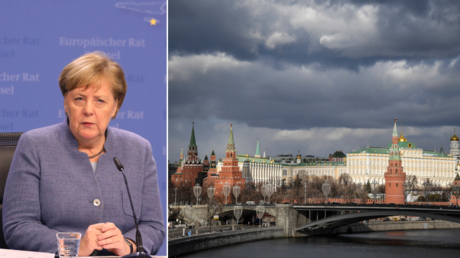
Germans are voting to elect a new parliament that will then replace the venerable Chancellor Angela Merkel. The race has been extremely tight, and the coalition-building to follow will likely be messy.
Polling stations opened across Germany on Sunday morning, with just over 60 million people eligible to vote.
The Bundestag officially has 598 seats, and all of them are being contested on this occasion. The actual number of seats may vary, however, due to the country’s complicated parliamentary system, which also features so-called leveling and overhang seats.
The end of the Merkel era
The election is the first in nearly 16 years not to feature Germany’s biggest political heavyweight, Chancellor Angela Merkel, who has served as chancellor since 2005. She first announced she would not seek reelection back in 2018, and her party, the Christian Democratic Union (CDU), has suffered a series of setbacks in regional elections since then.
The ongoing coronavirus pandemic has further eroded support for both the center-right CDU and its Bavarian sister party, the Christian Social Union (CSU), which are often referred to jointly as ‘the Union’.
The subsequent battle to represent the CDU/CSU as a candidate for chancellor was won by Armin Laschet, premier of the industrial North Rhine-Westphalia region, who only narrowly beat his Bavarian rival, Markus Söder.
Laschet’s campaign has suffered multiple gaffes, the worst occurring in July, when he was filmed laughing while President Frank-Walter Steinmeier was delivering a speech in a town devastated by catastrophic flooding. The incident dented Laschet’s image, further contributing to the CDU/CSU’s ratings decline.
Tight race with no clear winner
Pre-election opinion polls projected no clear favorite in the Bundestag race, but conclusively showed waning support for the conservative CDU/CSU alliance.
In early September, the Union’s support hit a record low of 20% – far below the nearly 33% result it achieved in the 2017 election. Meanwhile, its main rival, the center-left Social Democratic Party (SPD), led by Olaf Scholz, surged to 26% support in mid-September.
As of Friday, polls show the two main contenders separated by just 3%, with the SPD taking a slim lead with 25% and the CDU/CSU garnering around 22% support.
Neither side is expected to emerge from Sunday’s vote with an outright majority, and when polling stations close, the frantic business of coalition-building will begin. It took six months for the current CDU/CSU/SPD coalition to come together after the 2017 elections, and new alliances will likely be hammered out this time around, especially without Merkel in the picture to play a linchpin role.
An alliance between the CDU/CSU and the Greens has been predicted by pundits for months. With climate change the most important issue for German voters, the Greens are currently polling at between 14% and 16%, nearly double the 8.4% share they got in 2017.
However, with the SPD surging in popularity, Scholz’s party could woo the Greens away from the CDU/CSU with a three-way alliance involving the Linke party, currently polling at around 7%.
However, most of Germany’s political establishment balks at working with Linke, which is widely seen as the descendant of the old East German Communist Party.
Impending leftward shift?
Merkel has stepped in personally in a bid to prevent this, warning parliament earlier this month that the country may be headed for a left-wing coalition government. The chancellor bluntly warned against this, urging voters to show more support for her embattled successor, Laschet, who, she said would form a “federal government that leads our country into the future with moderation.”
In an uncharacteristic rebuke to the SPD, her coalition partners since 2013, Merkel said citizens faced a choice between a moderate government and one that might see the SPD accept the support of Linke and the Greens.
Laschet struck a similar tone, as he grilled his rival Scholz during a series of television debates. “You have to have a clear position on the extremists,” he said, referring to Linke. “I don’t understand why it’s so hard for you to say, ‘I won’t enter into a coalition with this party.’”
The prospect of the emergence of a left-wing coalition including Linke is far from certain, however. While the party itself signaled its readiness to partner with the SPD and the Greens, Scholz has said his preferred coalition would be with the Greens, and has previously described Linke as unfit for government.
The CDU/CSU could counter an SPD/Green coalition by bringing in both the Greens and the liberal Free Democratic Party (FDP), currently polling at around 12%. However, such a coalition would be complicated by the FDP’s economic libertarianism, which would clash with the debt-financed spending pushed by the Greens.
The growth of the Greens has been paralleled by the rise of the anti-establishment Alternative For Germany (AfD). Currently the third-largest party in the Bundestag, AfD is polling at around 12%. The party made a name for itself by vocally opposing Merkel’s “open doors” immigration policies, and has positioned itself as a champion of the relatively disadvantaged east, protesting the planned closure of coal mines and calling for urban regeneration.
However, climate change has topped immigration as a voters’ main concern, and although it is the country’s third-largest party, AfD has no realistic path to power, with all other parties ruling out a coalition with the right-wing force.
Think your friends would be interested? Share this story!
source: RT
Împotriva articolelor redacției noastre, persoanele nemulțumite pot formula Contestație în termen de 10 zile de la publicarea articolului, la judecătoria Orășenească nr. 1 München Bayern Deutschland, in conformitate cu Legea federală Germană. Considerăm că nu se pot formula acțiuni la instanțele din România deoarece nici o persoană care activează în trustul nostru nu poate fi extrasă de sub jurisdicția federală germană. Considerăm că redacția noastră nu răspunde în fața autorităților din România ci doar celor federale sau civile germane. deoarece legea română nu are efecte de extraneitate asupra redacției chiar dacă subiectul știrilor face obiectul unor evenimente sau persoane din România și sunt scrise în limba română. Limba română nu este izvor de extraneitate a legii.
absolvent WEB DESIGN Academia Britanică de Comunicare Iasi - absolvent COMUNICARE IN AFACERI Academia Britanica de Afaceri si Comunicare -absolvent JURNALISM EDITORIAL - London School University - 2019 inscris la echivalare diploma la Universitatea Politehnica Timisoara - absolvent studii de Drept Universitatea Europeană Drăgan, cursuri in Drept la Universitatea de Vest Timisoara, absolvent studii de proiectare, pastor coordonator in Biserica Protestanta Evanghelica,
Android Developer pe Google Play și plugin developer la Oxwall, creator de teme Wordpress și Oxwall, operator Wordpress, Drupal, Oxwall, Osclass, Moodle, tehnologii HTML și PHP
Haiti’s top prosecutor was fired and replaced after calling for charges against the country’s prime minister for the murder of President Jovenel Moise, though a dismissal letter claimed it related to an “administrative error.” Chief public prosecutor Bed-Ford Claude was terminated on Tuesday, with a new replacement sworn in just hours after Claude asked a […]
Protesters in Sudan were met with tear gas as they marched in the country’s capital Khartoum on Tuesday. They told RT they want the nation to return to full civilian rule after the military seized power in October. Security forces fired tear gas and stun grenades to disperse protesters that chanted “Soldiers belong in the […]
A Marine battalion commander who went viral for criticizing the United States’ chaotic withdrawal from Afghanistan was discharged just days before Christmas and is now preparing a ‘media blitz’ in response. Lt. Col. Stuart Scheller went viral in August after he published a Facebook video criticizing US military leadership for the way it handled the […]