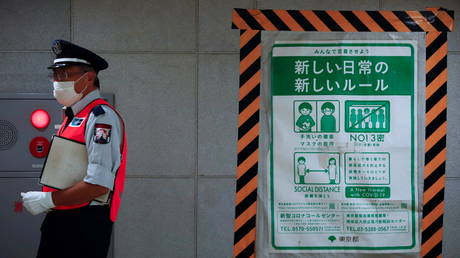
Subways were packed, airlines saw a spike in reservations, and bars in Tokyo resumed selling alcohol on Friday as Japan ended its state of emergency, leaving the country without any restrictions for the first time since April.
The decision to lift Covid-19 curbs was made by the government of outgoing Prime Minister Yoshihide Suga earlier this week as infection numbers dropped. It came into force on Thursday. The number of daily cases has now fallen to less than 1,600, compared to around 25,000 at the peak of the outbreak in August, easing pressure on the country’s health system.
The improvement in the epidemiological situation has been attributed to the country’s vaccination drive, as 59% of the population have already received two shots of a Covid-19 jab, along with the willingness of Japanese citizens to follow public health guidelines.
Tokyo and 18 other prefectures have been under a state of emergency for months, while a so-called quasi-state of emergency remained in place in eight other prefectures. Japan, which has a population of 125 million, is divided into 47 prefectures, meaning the curbs covered more than half of the country. The latest state of emergency was introduced in Tokyo in July before the opening of the Summer Olympics.
However, Japanese anti-coronavirus measures weren’t nearly as harsh as the lockdowns and curfews introduced in many other countries. Under the state of emergency, people were asked to refrain from traveling, limit outings for nonessential reasons, and avoid crowded places, while restaurants and bars were banned from selling booze and told to close by 8pm.
The government now plans to gradually ease various restrictions to revive the economy following the impact of Covid-19, while simultaneously avoiding a resurgence of the virus.
Early on Friday, trains on the Tokyo subway were packed with mask-wearing passengers as many employees were returning to their workplaces after a lengthy period of working from home – despite the approaching Typhoon Mindulle bringing rain and strong winds to the capital area.
“I feel it’s a new start,” an office clerk, who was back in the office after a year of working remotely, told AP.
The country’s largest carrier, All Nippon Airways, said that it had received 50,000 reservations since the lifting of the state of emergency was announced, which was 10 times more compared to a month ago.
The number of visitors allowed at concerts, sporting events and other mass gatherings has been increased from 5,000 to 10,000, with Tokyo Disney Resort and Universal Studios Japan theme parks already saying that they’re going to let in as many people as the new limit allows.
Alcohol has returned to Japanese restaurants and bars, while establishments with sufficient anti-coronavirus measures are permitted to stay open an hour longer, till 9pm.
“I really want to welcome this as a first step,” Atsunori Matsuda, who owns a place in Tokyo’s Shimbashi district, told Kyodo News. “Not having alcohol at an eatery had been a huge blow,” the 80-year-old complained. But Matsuda now expects things to improve, sending emailed invitations to customers and ordering barrels of sake.
Since the start of the pandemic in December 2019, Japan has seen almost 1.7 million cases of Covid-19 and over 17,600 deaths related to the virus.
Like this story? Share it with a friend!
source: RT
Împotriva articolelor redacției noastre, persoanele nemulțumite pot formula Contestație în termen de 10 zile de la publicarea articolului, la judecătoria Orășenească nr. 1 München Bayern Deutschland, in conformitate cu Legea federală Germană. Considerăm că nu se pot formula acțiuni la instanțele din România deoarece nici o persoană care activează în trustul nostru nu poate fi extrasă de sub jurisdicția federală germană. Considerăm că redacția noastră nu răspunde în fața autorităților din România ci doar celor federale sau civile germane. deoarece legea română nu are efecte de extraneitate asupra redacției chiar dacă subiectul știrilor face obiectul unor evenimente sau persoane din România și sunt scrise în limba română. Limba română nu este izvor de extraneitate a legii.
absolvent WEB DESIGN Academia Britanică de Comunicare Iasi - absolvent COMUNICARE IN AFACERI Academia Britanica de Afaceri si Comunicare -absolvent JURNALISM EDITORIAL - London School University - 2019 inscris la echivalare diploma la Universitatea Politehnica Timisoara - absolvent studii de Drept Universitatea Europeană Drăgan, cursuri in Drept la Universitatea de Vest Timisoara, absolvent studii de proiectare, pastor coordonator in Biserica Protestanta Evanghelica,
Android Developer pe Google Play și plugin developer la Oxwall, creator de teme Wordpress și Oxwall, operator Wordpress, Drupal, Oxwall, Osclass, Moodle, tehnologii HTML și PHP
A blaze which broke out in the early hours of Monday morning under a Paris bridge is being tackled by the city’s firefighters. No injuries have been reported, and emergency services say there is no danger of the bridge collapsing. Paris’s emergency services were called to a fire under the Pont National in the 13th […]
Thousands of users reported problems with Twitter on outage website Downdetector Twitter was briefly down for many people, with users reporting problems accessing the site and the app from around 4pm GMT on Thursday. Users found they were unable to load new tweets or view profiles. Downdetector received more than 4,500 outage reports in just 15 […]
Doug Ford’s order comes as anti-mandate protesters cut off US-Canada traffic along a key bridge Ontario Premier Doug Ford declared a state of emergency for the Canadian province on Friday, giving police the power to fine or imprison protesters demonstrating against vaccine mandates in the city of Ottawa and elsewhere in the region. Announcing his […]