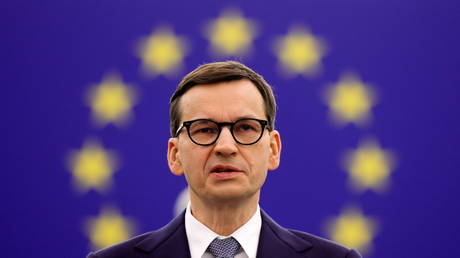
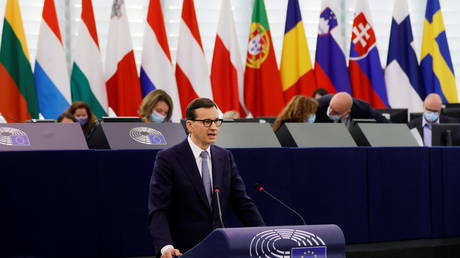
Poland joined the EU to protect its sovereignty, but its idea of the bloc clashes with that of the original members, political columnist Mary Dejevsky told RT. But, she says, despite the rule-of-law row Warsaw’s exit is unlikely.
The bitter row between the EU and Poland, revolving around the country’s rule of law in general and the disciplinary chamber of its Supreme Court in particular, will be a very difficult issue for the union to resolve, Dejevsky, a veteran foreign correspondent who worked in Moscow, Paris, Washington and China, and is a foreign affairs columnist at the Independent, believes.
Moreover, Poland is not the only EU nation with motives for joining entirely different from those of the original members of the European bloc, so similar conflicts may arise again, Dejevsky believes.
“It’s going to be very difficult for the European Union, because Poland is not the only country that joined the European Union with a different idea of why it was joining from the idea that united the original members,” she told RT on Tuesday. “Their idea was European peace, that there should never be a war in Europe again.”
Poland, as well as “some of the other countries that joined after the end of the Cold War,” had joined the EU with a fundamentally different idea in mind, seeking to “protect their security, their independence and their national character, national identity,” the columnist added.
The original idea was about sacrificing a degree of sovereignty to the European Union, and that’s almost the opposite of the idea of the countries like Poland joined with.
While a different vision of the reasons to stay within the bloc results in flashpoints like the rule-of-law row between Brussels and Warsaw, Poland is unlikely to actually leave the bloc, despite its bold rhetoric, Dejevsky believes. Membership is way too beneficial for Warsaw, while collisions with Brussels are actually a bigger problem for the EU than for Poland itself, she remarked.
“Whether that could lead to a Polish equivalent of Brexit, I think, almost to the very same reasons, it won’t lead to a Polish ‘Prexit’ or whatever it might be [called], because membership of the European Union is far too important as a protection for Poland,” Dejevsky explained.
Despite repeatedly standing by its controversial judiciary reform and brushing off EU threats to cut funding or implement other restrictions, Poland ultimately folded to the pressure on Tuesday. The country’s PM Mateusz Morawiecki announced the government will dissolve the controversial disciplinary chamber of the country’s Supreme Court.
Similarly to the intra-EU clashes, the tensions between the EU and its eastern neighbor, Russia, also have their roots in the Cold War era, Dejevsky believes. In the West, many decision-makers still treat Russia as an offshoot of a Soviet Union, while the two are actually “completely different,” she said.
“There’re two main obstacles. One of them is just still the shadow of the Cold War,” Dejevsky said. “The other aspect is that there’re points on which there’s a genuine difference between Russia and the West. One of those has been the expansion of NATO and the European Union.”
While the expansion of these entities appeared like a “good thing” from a Western perspective, for Moscow the process looked like a “threat for Russia’s national interest and Russia’s security.” This, as well as other issues, makes for “genuine conflict of interests,” and without talking them through “honestly” it would be very difficult to get a “new understanding” between Moscow and the West, Dejevsky feared.
Think your friends would be interested? Share this story!
source: RT
Împotriva articolelor redacției noastre, persoanele nemulțumite pot formula Contestație în termen de 10 zile de la publicarea articolului, la judecătoria Orășenească nr. 1 München Bayern Deutschland, in conformitate cu Legea federală Germană. Considerăm că nu se pot formula acțiuni la instanțele din România deoarece nici o persoană care activează în trustul nostru nu poate fi extrasă de sub jurisdicția federală germană. Considerăm că redacția noastră nu răspunde în fața autorităților din România ci doar celor federale sau civile germane. deoarece legea română nu are efecte de extraneitate asupra redacției chiar dacă subiectul știrilor face obiectul unor evenimente sau persoane din România și sunt scrise în limba română. Limba română nu este izvor de extraneitate a legii.
absolvent WEB DESIGN Academia Britanică de Comunicare Iasi - absolvent COMUNICARE IN AFACERI Academia Britanica de Afaceri si Comunicare -absolvent JURNALISM EDITORIAL - London School University - 2019 inscris la echivalare diploma la Universitatea Politehnica Timisoara - absolvent studii de Drept Universitatea Europeană Drăgan, cursuri in Drept la Universitatea de Vest Timisoara, absolvent studii de proiectare, pastor coordonator in Biserica Protestanta Evanghelica,
Android Developer pe Google Play și plugin developer la Oxwall, creator de teme Wordpress și Oxwall, operator Wordpress, Drupal, Oxwall, Osclass, Moodle, tehnologii HTML și PHP
A passenger train has derailed in India, and several carriages have overturned An express train has crashed in eastern India, with multiple cars coming off the tracks and overturning. At least five people were killed in the incident and more than 50 were hospitalized. The accident occurred in India’s West Bengal state on Thursday, when […]
The Metropolitan Detention Center in Albuquerque went into lockdown after the attack disrupted vital systems A suspected ransomware attack in New Mexico has disrupted services across an entire county, including a local jail in Albuquerque that went into lockdown after losing access to camera feeds, databases, and automatic doors. The incident, which occurred on January […]
Astronauts on the moon or Mars may be growing their homes, rather than building them, according to NASA. sursa Împotriva articolelor redacției noastre, persoanele nemulțumite pot formula Contestație în termen de 10 zile de la publicarea articolului, la judecătoria Orășenească nr. 1 München Bayern Deutschland, in conformitate cu Legea federală Germană. Considerăm că nu se […]