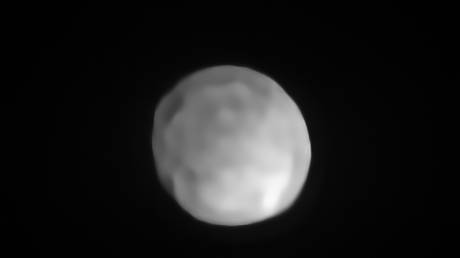
The current definition of a “planet” is rooted in folklore and astrology, and must be dropped due to not meeting the needs of modern astronomy, a new study states, opening the doors for the Pluto comeback.
Pluto was discovered in the ring of bodies beyond the orbit of Neptune, known as the Kuiper belt, back in 1930, being declared the ninth planet in the Solar System.
However, its status was questioned after several other objects of the same size were found in the Kuiper belt, with the International Astronomical Union (IAU) eventually downgrading Pluto to “dwarf planet” in 2006.
It happened in line with the new definition of a “planet” adopted by the IAU, which stated that a celestial body has to orbit the Sun, have a nearly round shape and be gravitationally dominant, clearing its own orbit, to meet the criteria.
Pluto ended up being disqualified because its orbit intersects with that of Neptune and because it shares its orbital neighborhood with other objects in the Kuiper belt.
The rule demanding a planet to clear its own orbit “was really developed post facto to keep an orderly, small number of planets,” Philip Metzger, from the Florida Space Institute at the University of Central Florida (UCF), said.
And the very idea that there should be a limited number of planets has little to do with science, stemming from folklore and astrology, he pointed out.
In order to prove that point, Metzger and his team studied a massive bulk of planetary literature from the past 400 years, sharing the results of five years of their work in the Icarus astronomical magazine.
According to the paper, entitled ‘Moons are planets,’ the definition introduced by Galileo in the 1600s – that a planet only needed be a geologically active body in space – had been used by scientists throughout much of history and only eroded in the 20th century.
It happened between the 1910s and 1950s, when the decline in the number of papers on planetary science coincided with the rise of publications such as almanacs, Metzger told UCF Today.
“There were enough almanacs being sold in England and in the US that every household could get one copy every year.”
Those almanacs provided its readers with a whole range of information – from calendars of astronomical events to cooking recipes and fiction. But there was also a heavy emphasis on astrology, including astrological weather forecasts that can only be made if there was a limited number of planets.
“This was a key period in history, when the public accepted that the Earth orbits the Sun instead of the other way around, and they combined this great scientific insight with a definition of planets that came from astrology,” Metzger said.
And those views that moons and satellites shouldn’t be considered planets then made their way into scientific literature. But this definition doesn’t work anymore as astronomy relies on advanced technology that allows it to study space much more thoroughly, he added.
“There’s an explosion in the number of exoplanets that we’ve discovered over the last 10 years, and that’s only going to increase as we put better telescopes in space.”
“We need to fix this [the definition of a ‘planet’] now before we get too far in this revolution with exoplanets. We want to be doing excellent science because this great influx of data is making it vastly more important to define our new discoveries correctly.”
Metzger and his colleagues are pushing for the return to Galileo’s definition, and if their call is heard Pluto will become a planet again, with numerous other celestial bodies joining it.
source: RT
Împotriva articolelor redacției noastre, persoanele nemulțumite pot formula Contestație în termen de 10 zile de la publicarea articolului, la judecătoria Orășenească nr. 1 München Bayern Deutschland, in conformitate cu Legea federală Germană. Considerăm că nu se pot formula acțiuni la instanțele din România deoarece nici o persoană care activează în trustul nostru nu poate fi extrasă de sub jurisdicția federală germană. Considerăm că redacția noastră nu răspunde în fața autorităților din România ci doar celor federale sau civile germane. deoarece legea română nu are efecte de extraneitate asupra redacției chiar dacă subiectul știrilor face obiectul unor evenimente sau persoane din România și sunt scrise în limba română. Limba română nu este izvor de extraneitate a legii.
absolvent WEB DESIGN Academia Britanică de Comunicare Iasi - absolvent COMUNICARE IN AFACERI Academia Britanica de Afaceri si Comunicare -absolvent JURNALISM EDITORIAL - London School University - 2019 inscris la echivalare diploma la Universitatea Politehnica Timisoara - absolvent studii de Drept Universitatea Europeană Drăgan, cursuri in Drept la Universitatea de Vest Timisoara, absolvent studii de proiectare, pastor coordonator in Biserica Protestanta Evanghelica,
Android Developer pe Google Play și plugin developer la Oxwall, creator de teme Wordpress și Oxwall, operator Wordpress, Drupal, Oxwall, Osclass, Moodle, tehnologii HTML și PHP
South Africa’s president Cyril Ramaphosa was caught on video dancing maskless during a trip to Ghana, only days before he tested positive for Covid-19, as his country battles a wave of cases sparked by the Omicron variant. The footage, circulating on Twitter, shows Ramaphosa, 69, forgoing a mask while dancing with a partner, as music […]
The state’s Department of Health placed the official on leave after he called his employees’ low vaccination rate “pathetic” and urged them to get the jab. The Florida Department of Health has suspended one of its top officials over an email in which he criticized his employees for their vaccine hesitancy. The department is probing […]
Brigitte Macron is dragging two women to court for publishing scandalous claims about her online Brigitte Macron, wife of French President Emmanuel Macron, has sued two women who spread rumors that she underwent a sex change, according to an AFP report on Friday. The case comes as her husband gears up for a tough reelection […]