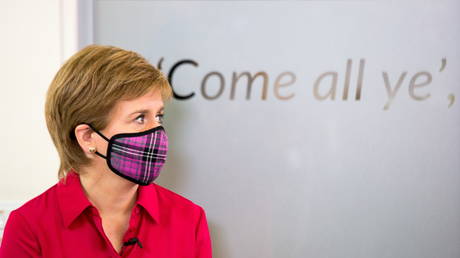
Edinburgh court rejects 2018 law that attempted to include trans women under the legal definition for women
The Scottish government has lost a legal battle over a gender representation law that “expanded the definition of women” to include transgender people. Women’s rights activists had argued that the legislation violated “protected characteristics” related to sex in the UK’s 2010 Equality Act.
The Court of Session in Edinburgh ruled on Friday that the Scottish National Party (SNP) government had overstepped its authority when drafting the Gender Representation on Public Boards Scotland Act in 2018, which implemented 50% quotas for women on public sector boards.
Under the law, an individual “living as a woman” who plans to undergo (or has undergone) a “process for the purpose of becoming female” should be considered on par with biological women when filling these quotas. It invoked the “protected characteristic” of gender reassignment.
But the court stated that by “incorporating those transsexuals living as women into the definition of woman,” the legislation “conflates and confuses” two different protected characteristics. The three judges hearing the case said the ruling was not about the “rights and wrongs” of the trans rights debate, but whether the legislation fell under Holyrood’s devolved powers.
The definition of ‘woman’ adopted in the 2018 act “impinges on the nature of protected characteristics which is a reserved matter,” the ruling states, adding that “changing the definitions” of what constituted a protected characteristic is “not permitted” since it would negate laws passed by Westminster. The court said that the government should have instituted separate quotas for transgender people instead.
The judges noted that the definition used in the legislation would, in theory, make it possible for public boards to achieve their gender quota without adding a single board member who is a biological woman.
The law was challenged by campaign group For Women Scotland (FWS), which had appealed to the court after losing a judicial review last year. FWS director Trina Budge told The Telegraph that the act would have “allowed men who had not had to deal with pregnancy or workplace motherhood penalties to take advantage simply by taking on a woman’s name and adopting female pronouns.”
“We are delighted that this has been corrected in law and that the judges have restated that the protected characteristic of sex refers to either a male or a female and that provisions in favour of women must, by definition, exclude those who are biologically male,” Budge added.
Meanwhile, an unnamed spokeswoman told the paper that the SNP government was “disappointed by the outcome and are considering its terms.” It will either have to strike out the definition of women from the legislation, or take the case to the UK Supreme Court, the paper reported.
source: RT
Împotriva articolelor redacției noastre, persoanele nemulțumite pot formula Contestație în termen de 10 zile de la publicarea articolului, la judecătoria Orășenească nr. 1 München Bayern Deutschland, in conformitate cu Legea federală Germană. Considerăm că nu se pot formula acțiuni la instanțele din România deoarece nici o persoană care activează în trustul nostru nu poate fi extrasă de sub jurisdicția federală germană. Considerăm că redacția noastră nu răspunde în fața autorităților din România ci doar celor federale sau civile germane. deoarece legea română nu are efecte de extraneitate asupra redacției chiar dacă subiectul știrilor face obiectul unor evenimente sau persoane din România și sunt scrise în limba română. Limba română nu este izvor de extraneitate a legii.
absolvent WEB DESIGN Academia Britanică de Comunicare Iasi - absolvent COMUNICARE IN AFACERI Academia Britanica de Afaceri si Comunicare -absolvent JURNALISM EDITORIAL - London School University - 2019 inscris la echivalare diploma la Universitatea Politehnica Timisoara - absolvent studii de Drept Universitatea Europeană Drăgan, cursuri in Drept la Universitatea de Vest Timisoara, absolvent studii de proiectare, pastor coordonator in Biserica Protestanta Evanghelica,
Android Developer pe Google Play și plugin developer la Oxwall, creator de teme Wordpress și Oxwall, operator Wordpress, Drupal, Oxwall, Osclass, Moodle, tehnologii HTML și PHP
The US Department of Justice has created a special squad to target homegrown extremism, citing a rise in “anti-government and anti-authority ideologies” The DOJ is ramping up its efforts to combat domestic terrorism, forming a specialized unit to address what it sees as growing threats of attacks from within the American populace. The department already had […]
RT has got a sneak peek into the Taliban’s drugs war by talking to patients and doctors at a Kabul hospital. The group promised a ‘narcotics-free’ Afghanistan as it took power in mid-August and has since set some plans in motion. Millions of Afghans are addicted to drugs. Up to 10% of the nation’s population […]
Tech giant Microsoft has followed Facebook into the Metaverse – after a fashion. Users of its Teams collaborative software will be able to appear as virtual avatars in fantasy workspaces, a step toward Facebook’s immersive VR. Microsoft is rolling out a more Metaverse-like version of its popular Teams videoconferencing program, offering users the option of […]