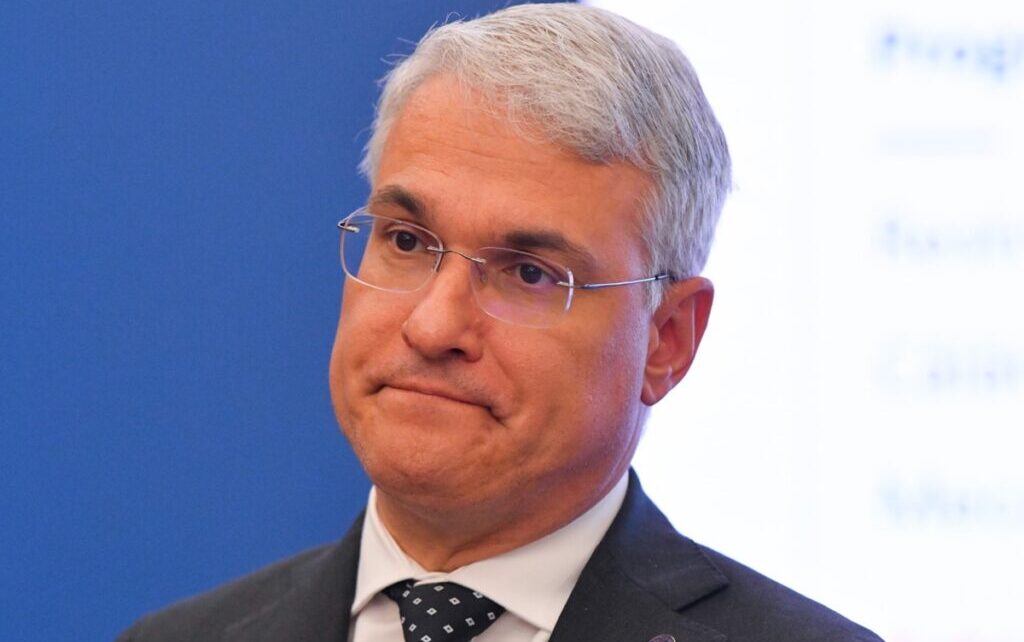
Acting Minister of Labor, Dragoș Pîslaru, announced on Wednesday that he has been given a mandate by interim Prime Minister Ilie Bolojan to negotiate with the European Commission regarding the possibility of freezing or staggering salary increases for public officials until 2031, as part of public sector salary reform.
He emphasized, “Officials should not be the recipients of the largest net salary increases while other employee categories face limited or nonexistent raises due to the available budget.”
Negotiation Mandate in Brussels
In a Facebook post, the Labor Minister explained that he will travel to Brussels to advocate for this position in discussions on the PNRR with the European Commission.
“I have been given the mandate to discuss with the European Commission the possibility of freezing or staggering salary increases for officials until 2031. Following discussions with Prime Minister Ilie Bolojan, I will head to Brussels next week to support this stance during the final renegotiation of the PNRR,” Dragoș Pîslaru wrote on Facebook.
He noted that this is a sensitive issue and that there is already a position from the European Commission regarding the implementation of the salary law.
“I understand this is a delicate topic. I also recognize that the European Commission’s written position so far has been that the future salary law should be applied uniformly across the public sector. Nonetheless, I feel it is my duty to use all available arguments to seek a different evaluation,” Pîslaru added.
Pîslaru further stated that “a unified salary reform is necessary to bring order, predictability, and fairness in a system burdened with too many exceptions, bonuses, and imbalances.”
According to Pîslaru, the discussion is not about removing a unified grid but about its application, including for officials.
“The debate is not over whether the law should be unified, including a harmonized grid for officials. Romania is too poor not to adequately and uniformly compensate those in charge of governance. This isn’t about individual merit but about attracting skilled and competent individuals to public office roles. Romania is in a challenging fiscal and social context. We need balance, responsibility, and a fair distribution of effort,” the minister explained.
“Freezing or Staggering” Until 2031
He further clarified that under current conditions, officials should not enjoy the highest salary increases.
“In such times, even if there were an objective reshuffling of grids, officials cannot receive the largest net salary increases while other employee categories face limited or nonexistent increases due to budget constraints.”
“Our society is deeply divided, and the public perception of unequal reform benefits directly impacts the chances of law adoption. Fairness must be visible not only in the final occupational hierarchy but also in the effort over time required from public officeholders compared to other occupational families. A temporary freeze or at least a rescheduling is more than appropriate given the circumstances. By 2031, we aim to honor our commitment to full and uniform implementation, including for officials,” the minister emphasized.
Dragoș Pîslaru also stated in writing that he will go to Brussels with a mandate to support a reform deemed necessary.
“I cannot guarantee the outcome of the discussions. However, I can assure you that I will do everything in my power to firmly and convincingly support this position,” Pîslaru added.
Interim Prime Minister Ilie Bolojan confirmed that the Labor Minister has been mandated to negotiate with the European Commission for a possible staggered increase of officials’ salaries during the PNRR reform discussions.
Împotriva articolelor redacției noastre, persoanele nemulțumite pot formula Contestație în termen de 10 zile de la publicarea articolului, la judecătoria Orășenească nr. 1 München Bayern Deutschland, in conformitate cu Legea federală Germană. Considerăm că nu se pot formula acțiuni la instanțele din România deoarece nici o persoană care activează în trustul nostru nu poate fi extrasă de sub jurisdicția federală germană. Considerăm că redacția noastră nu răspunde în fața autorităților din România ci doar celor federale sau civile germane. deoarece legea română nu are efecte de extraneitate asupra redacției chiar dacă subiectul știrilor face obiectul unor evenimente sau persoane din România și sunt scrise în limba română. Limba română nu este izvor de extraneitate a legii.