The European Commission’s decision on Friday marks a significant milestone for Transgaz, following years of meetings, discussions, and substantial investments by Romania’s national gas transmission and system operator aimed at enhancing the country’s bidirectional gas flows.
This case, initiated in June 2016, focused on concerns about potential strategic delays in developing interconnections with neighboring countries, which might have restricted gas exports. The investigation concluded successfully in 2020, with Transgaz avoiding a potential fine amounting to 10% of its turnover by committing to increase capacity at interconnection points. This was crucial for exporting additional volumes of natural gas, particularly to Hungary and Bulgaria.
To address the European Commission’s concerns, Transgaz made several commitments. The Commission sought feedback from market participants to ensure these commitments would resolve the competitive issues identified. Following this market test, Transgaz refined its commitments, ensuring that market participants could access significant export capacities through interconnection points with neighboring EU member states. Specifically, Transgaz committed to:
– Providing a minimum export capacity of 1.75 billion cubic meters annually at the Romanian-Hungarian interconnection point (Csanádpalota), equating to about one-sixth of Hungary’s annual gas consumption.
– Making a total minimum export capacity of 3.7 billion cubic meters annually available at two Romanian-Bulgarian interconnection points (Giurgiu/Ruse and Negru Vodă I/Kardam), covering more than half of Bulgaria’s and Greece’s annual gas consumption.
– Ensuring that its tariff proposals to Romania’s National Energy Regulatory Authority (ANRE) would not discriminate between export and domestic tariffs, thus preventing commercially unviable interconnection tariffs.
– Refraining from employing other means to obstruct exports.
The final commitments include significantly more capacity, especially towards Hungary, integrating expected capacities from the Romanian section of the first phase of the Bulgaria-Romania-Hungary-Austria (BRUA) gas pipeline project. As a result, Transgaz’s participation in this project comes with legally binding deadlines. The commitments will remain in effect until December 31, 2026, with a trustee appointed to monitor their implementation and compliance.
The European Commission concluded that Transgaz’s modified commitments adequately addressed the competition concerns and therefore imposed legally binding obligations on Transgaz. Six years later, in May 2026, the commitments were revisited to allow Transgaz to offer competitive export capacities at two interconnection points: one with Bulgaria and another with Ukraine, using the same gas pipeline.
In essence, as clarified by the European Commission, competitive capacities are those that cannot be allocated without reducing the capacity offered at another point. These capacities are made available to the market through auctions and allocated based on demand, according to a statement from the Brussels Executive.
“Enhancing the Country’s Role in European Energy”
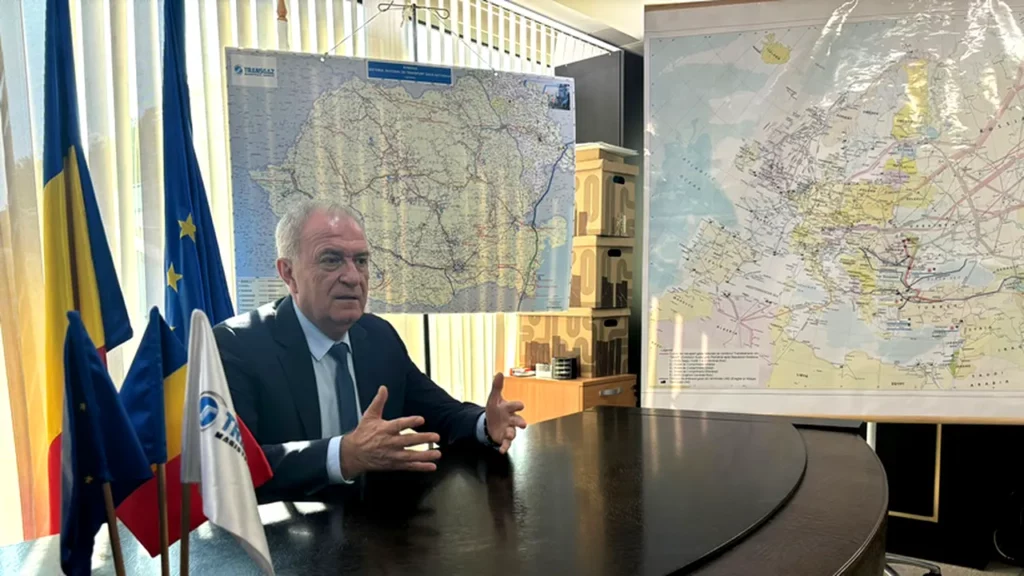
The current decision by the European Commission enables Transgaz to auction capacity reservation packages—essentially guaranteed access for gas transit across national territory—at both interconnection points on the trans-Balkan corridor. Ion Sterian, the General Director of Transgaz, elaborates on the chronology and significance of this decision in a detailed discussion with Mediafax.
Reporter: What was happening with gas transport at the time of Transgaz’s commitments?
Ion Sterian: By summer 2020, the commitments were finalized. At that time, transit on the trans-Balkan corridor from Russia, Ukraine, Bulgaria, Macedonia, Greece, and Turkey was not halted. The Turkish Stream 2 was not yet built, and work continued in Bulgaria until its completion on January 1, 2021. This allowed Russia to deliver gas directly to Bulgaria, rendering the trans-Balkan corridor from Ukraine to Bulgaria’s Strandja area inoperative.
Reporter: What prompted Transgaz to request a revision of the commitments?
Ion Sterian: The conditional capacity was hindering the Vertical Corridor, especially with LNG (Liquefied Natural Gas) from American terminals at Revithoussa and Alexandroupolis. We worked with the European Commission’s Director-General for Energy to operationalize this corridor by reducing tariffs and improving gas flows. We’ve significantly reduced tariffs at the Isaccea interconnection point and in Moldova, where we operate the system through Vestmoldtransgaz, reducing tariffs at Căușeni by 90%.
Reporter: Does this decision mean an automatic price reduction for capacity reservation?
Ion Sterian: Prices have already been reduced with these discounts. However, no traders participated in the recent auction despite the reduced tariffs, partly due to ongoing infrastructure work in Bulgaria.
Reporter: What benefits does Transgaz and Romania gain from this decision?
Ion Sterian: The main advantage is the increased transit of gas through Romania, generating revenue for Transgaz, which translates into taxes, state budget contributions, and dividends for the Romanian state. This decision enhances the role and prestige of the country in Eastern, Central Europe, and the Balkans, reducing dependence on Russian gas. The European Commission aims to ban Russian gas trade in the EU from January 1, 2027.
Reporter: You mentioned how Transgaz’s 2020 victory became a study case in universities.
Ion Sterian: It was a challenging case for DG Competition. They intended to fine us, but we provided all necessary arguments and commitments, which we implemented. Projects like the BRUA pipeline and connecting Moldova to Romania’s gas infrastructure have granted Moldova energy independence from Russian gas. Our efforts have transformed the energy landscape, making us a significant gas hub and enhancing the country’s prestige.
This decision ultimately strengthens Romania’s position in the energy sector, contributing to regional energy security and independence while boosting national economy and prestige.
Împotriva articolelor redacției noastre, persoanele nemulțumite pot formula Contestație în termen de 10 zile de la publicarea articolului, la judecătoria Orășenească nr. 1 München Bayern Deutschland, in conformitate cu Legea federală Germană. Considerăm că nu se pot formula acțiuni la instanțele din România deoarece nici o persoană care activează în trustul nostru nu poate fi extrasă de sub jurisdicția federală germană. Considerăm că redacția noastră nu răspunde în fața autorităților din România ci doar celor federale sau civile germane. deoarece legea română nu are efecte de extraneitate asupra redacției chiar dacă subiectul știrilor face obiectul unor evenimente sau persoane din România și sunt scrise în limba română. Limba română nu este izvor de extraneitate a legii.