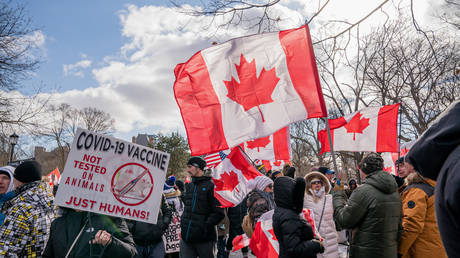
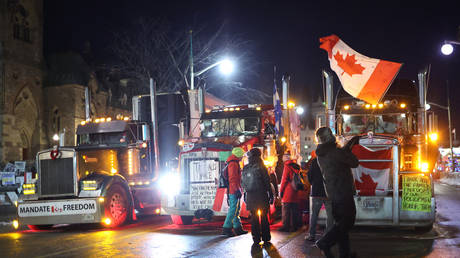
We are encouraged to believe that different experiences mean that some groups can never unite. The Freedom Convoy shows us the opposite is true.
Since a movement dubbing itself the ‘Freedom Convoy’ emerged at the end of January and headed to Ottawa to protest vaccine mandates for border crossings, labour leaders, the media and online activists have moved from perplexed to outright hostile. Some have even cheered on Canadian Prime Minister Justin Trudeau’s announcement this week of plans to invoke the 1988 Emergencies Act to clear out the protests. But the impulse to defend freedom and self-determination has attracted a diversity of groups to the cause. The fact that many indigenous have joined in support of the protests tells us that the desire for freedom is a spark we would do well not to extinguish.
Throughout their time in the Canadian capital, the truckers have attracted support from a wide cross section of Canadian society including indigenous Canadians who make up about 5% of the Canadian population. Many members of my own family joined the convoy, making their way south to Ottawa from Northern Ontario. Some joined in at the capital. Indigenous people appeared in full regalia and others wore orange T-shirts symbolising protest against atrocities at residential schools. While some groups within the convoy undoubtedly held different ideas about the underlying causes, two clear demands have emerged: 1) end covid-related mandates, and 2) roll back forms of digital surveillance enacted since the start of the pandemic. Summed up in the demand for ‘freedom’, indigenous and non-indigenous participants alike emphasised that this was a cause shared by everyone, regardless of background.
But the picture hasn’t all been rosy. The convoy is controversial, sparking deep rifts in the Canadian parliament, in wider Canadian society, and even in families and small communities. The truckers were condemned by their own labour unions, who sided with Trudeau’s government in favour of vaccine mandates. Similarly, indigenous leaders rejected indigenous involvement and warned their citizens that this was not their cause. Instead, they emphasised that indigenous people were needed in their own communities. The movement didn’t speak to the particulars of the indigenous people, they were told. In other words, this is not our fight.
But it is. Or at least it should be. Divide and conquer has become, unwittingly or not, the modus operandi of destruction for today’s social movements. Each group is encouraged to have their own cause and are discouraged from seeing unity across identity lines. This is not the first time this has happened. Few are aware that the enforcement of “Jim Crow” laws in the early 20th century was sparked by solidarity movements of poor black workers and poor white farmers in the American south. Their coming together presented a serious threat to the status quo that had to be put down. By encouraging one group to see their interests in their race rather than their class position, they were successful in splitting the movement into warring factions.
Despite having different sources, indigenous people have more in common, more even than the shared abandonment of the cause by their leaders. Both groups have strong reasons to reject surveillance. Truckers have been subject to increasingly intrusive levels of surveillance, long before the introduction of vaccine passes and ubiquitous QR codes. Their cabs have been fitted with driver-facing cameras, their every movement controlled and tracked by electronic logging devices. Similarly, indigenous people are some of the most monitored people in Canada – a fact attested to by the reality that children are being taken away in alarming numbers. No action goes unwatched. No ‘mistake’ goes unpunished.
Unfortunately, the left, indigenous leaders and the professional classes in general have found it difficult to make sense of any claims that can’t be transformed into social policies and new forms of surveillance. Thus, they have been receptive to claims for more monitoring, for ever-expanding definitions of ‘wellbeing’ that invite intrusion into more and more aspects of individual and family life, for ever more intrusive forms of health monitoring, and generally the types of surveillance the Freedom Convoy is rejecting. Their disavowal of the protests has meant that far-right conspiracy theorists have converged to fill the gap. Strange characters have given voice to real concerns because no one else would.
Truckers want to be treated as citizens and adults capable of making their own decisions, not just about what goes into their bodies, but also about how they live their lives and do their jobs. In this way, vaccine mandates are just a conduit for broader frustrations about the thwarting of their rational subjectivity. Instead, they are increasingly treated as objects whose right to self-determine is secondary to so many other demands.
So too has self-determination been one of the most longstanding demands of indigenous communities. But it has been continually demoted in favour of wellbeing, mental health and the need to ‘heal’. Instead, indigenous people have been transformed into objects, supposedly limited in their capacities by the ravages of colonialism and the residential school system. As one young woman put it, ‘We’re still experiencing the effects of the residential school from our parents and grandparents. We’re all damaged, and we’ll pass it on to our children, so it will never end.’ Self-determination seems continually distant. But some people are rejecting this vision. Like the truckers, they want more.
So many in Canadian society and around the world have not taken seriously the Freedom Convoy because they cannot take seriously the demands for freedom and self-determination. Labour unions and indigenous leaders discouraged their members from supporting the protests, pushing them instead to worry about safety and their own insular causes. This is because the interests of these leaders lie in the very forces this movement is opposing: greater surveillance and greater domination, but all for our own ‘protection’ and all for our ‘own good’. But many people have had different experiences that will nonetheless lead them to the same place: They want to be able to decide for themselves how they will live. The rest of the world had better sit up and listen.
source: RT
Împotriva articolelor redacției noastre, persoanele nemulțumite pot formula Contestație în termen de 10 zile de la publicarea articolului, la judecătoria Orășenească nr. 1 München Bayern Deutschland, in conformitate cu Legea federală Germană. Considerăm că nu se pot formula acțiuni la instanțele din România deoarece nici o persoană care activează în trustul nostru nu poate fi extrasă de sub jurisdicția federală germană. Considerăm că redacția noastră nu răspunde în fața autorităților din România ci doar celor federale sau civile germane. deoarece legea română nu are efecte de extraneitate asupra redacției chiar dacă subiectul știrilor face obiectul unor evenimente sau persoane din România și sunt scrise în limba română. Limba română nu este izvor de extraneitate a legii.
absolvent WEB DESIGN Academia Britanică de Comunicare Iasi - absolvent COMUNICARE IN AFACERI Academia Britanica de Afaceri si Comunicare -absolvent JURNALISM EDITORIAL - London School University - 2019 inscris la echivalare diploma la Universitatea Politehnica Timisoara - absolvent studii de Drept Universitatea Europeană Drăgan, cursuri in Drept la Universitatea de Vest Timisoara, absolvent studii de proiectare, pastor coordonator in Biserica Protestanta Evanghelica,
Android Developer pe Google Play și plugin developer la Oxwall, creator de teme Wordpress și Oxwall, operator Wordpress, Drupal, Oxwall, Osclass, Moodle, tehnologii HTML și PHP
The Hollywood star says authorities ‘can’t just go through your phone’ Alec Baldwin has denied he’s refusing to comply with a search warrant for his phone amid a probe into the shooting of cinematographer Halyna Hutchins, arguing authorities have to tell him what exactly they want from his device. In a video posted to Instagram […]
Figures showed that 2.5% of the more than £19 billion given in self-employment support was lost to fraud UK Chancellor Rishi Sunak has rejected media reports that the government had “written off” £4.3 billion ($5.76 billion) of Covid support that was stolen by fraudsters during the pandemic, despite setting up a taskforce to tackle scammers. […]
Jury finds Epstein’s ‘madam’ Ghislaine Maxwell guilty on sex trafficking charges in a high-profile trial Ghislaine Maxwell, a former confidant of sex trafficker and convicted pedophile Jeffrey Epstein, has been found guilty on five of six counts linked to helping the late financier groom and recruit teenage girls for abuse. The British socialite was convicted […]