Scientists claim that ultrasound pulses help medicine carriers to “non-invasively” pass the blood-brain barrier
A team of researchers in the UK claims to have identified a better and safer way to deliver drugs right to the brain by using ultrasound pulses to “non-invasively” clear the way for the carriers – medicine-filled lipid balls, known as liposomes.
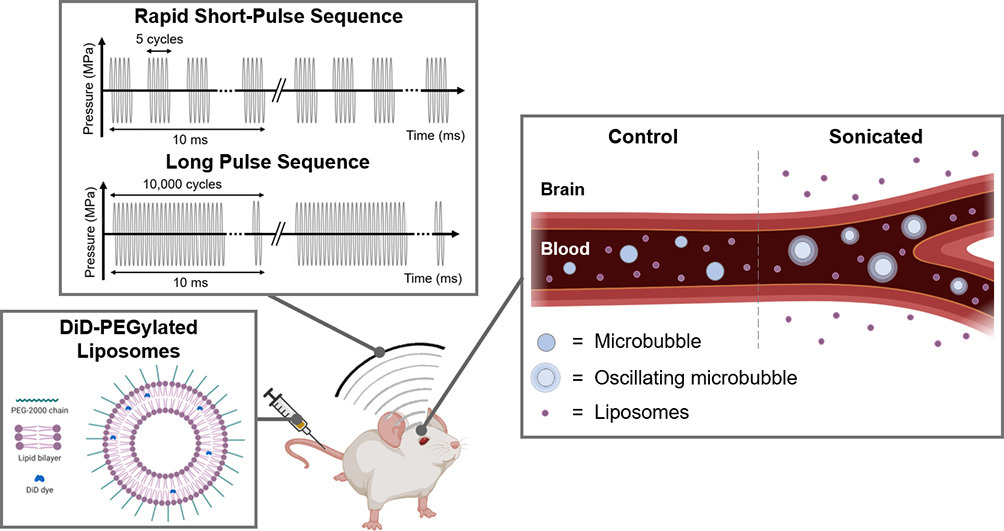
The experiments on mice were conducted by scientists from the King’s College London School of Biomedical Engineering & Imaging Sciences and the Noninvasive Surgery & Biopsy Laboratory. They used rapid short pulses of ultrasound (RaSP) to expand and contract microbubbles, which acted to open the brain’s barrier and safely draw in the liposomes, injected through the mouse’s tail.
“The RaSP sequence at both acoustic pressures provided a safer delivery while achieving higher delivery efficacy compared to the long pulse treatments at the lower pressure,” the scientists concluded. Their research was published in the latest issue of the Journal of Controlled Release.
The “improved safety profile and efficacy” of the innovative method allows it to “deliver large molecules to the brain without causing damage,” the scientists emphasized in their paper on the technique.
Commenting on the research, study co-author Aishwarya Mishra from the School of Biomedical Engineering & Imaging Sciences said the team’s other key finding “was the ability to study the liposomes being delivered to different types of neuronal cells showing the liposomes are taken up by these targets and can be used to treat the diseases associated with these cells.”
The issue of administering nanomedicines without damaging the blood-brain barrier could prove increasingly important across a number of treatments, with Kings College noting that liposomes – capable of carrying high drug concentrations – have shown potential in treating a number of diseases, including cancer.
The college highlighted Pfizer-BioNTech’s Covid-19 vaccine as one of the clinically-approved liposome formulations currently in use.
source: RT
Împotriva articolelor redacției noastre, persoanele nemulțumite pot formula Contestație în termen de 10 zile de la publicarea articolului, la judecătoria Orășenească nr. 1 München Bayern Deutschland, in conformitate cu Legea federală Germană. Considerăm că nu se pot formula acțiuni la instanțele din România deoarece nici o persoană care activează în trustul nostru nu poate fi extrasă de sub jurisdicția federală germană. Considerăm că redacția noastră nu răspunde în fața autorităților din România ci doar celor federale sau civile germane. deoarece legea română nu are efecte de extraneitate asupra redacției chiar dacă subiectul știrilor face obiectul unor evenimente sau persoane din România și sunt scrise în limba română. Limba română nu este izvor de extraneitate a legii.
absolvent WEB DESIGN Academia Britanică de Comunicare Iasi - absolvent COMUNICARE IN AFACERI Academia Britanica de Afaceri si Comunicare -absolvent JURNALISM EDITORIAL - London School University - 2019 inscris la echivalare diploma la Universitatea Politehnica Timisoara - absolvent studii de Drept Universitatea Europeană Drăgan, cursuri in Drept la Universitatea de Vest Timisoara, absolvent studii de proiectare, pastor coordonator in Biserica Protestanta Evanghelica,
Android Developer pe Google Play și plugin developer la Oxwall, creator de teme Wordpress și Oxwall, operator Wordpress, Drupal, Oxwall, Osclass, Moodle, tehnologii HTML și PHP
Jacob Rees-Mogg among the first to be moved, becoming minister for Brexit opportunities and government efficiency UK Prime Minister Boris Johnson, who has been under pressure to resign from his post following a series of scandals, shifted the job responsibilities of some members of his cabinet on Tuesday afternoon. The first announcement saw Jacob Rees-Mogg […]
US troops won’t partake in “combat operations,” but defense secretary didn’t rule out other roles for American soldiers Secretary of Defense Lloyd Austin told reporters that President Joe Biden “does not intend to put troops into Ukraine for combat operations.” However, Austin said that every possible military option short of a direct deployment is on […]
Other experts are skeptical, accusing the OpenAI researcher of “trolling” The co-founder of a San Francisco-based AI research laboratory claimed in a Twitter post this week that “today’s largest neural networks” could already be “slightly conscious.” Ilya Sutskever from OpenAI did not clarify what system or systems he was referring to, or how exactly he […]